


Arm Lift Surgery
Reviewed by Siamak Agha-Mohammadi, MD, PhD
Envious of First Lady Michelle Obama’s trim, tight and toned upper arms? You’re not alone. Her arms have inspired many to hit the gym to attempt to firm their droopy or sagging upper arms. For some people, exercise alone is not enough. For them, an arm lift (brachioplasty) may be an option.
An arm lift — with or without liposuction — can help your arms go from “flabulous” to fabulous. This procedure can create a sculpted upper arm that complements your figure and your wardrobe. Today’s arm lift techniques are safer and the scars much less conspicuous than in the past.
Check out the lastest arm lift statistics courtesy of the American Society of Plastic Surgeons
Candidates for Arm Lift
Arm lift is one of the top four most popular plastic surgery procedures performed following massive weight loss, according to the American Society of Plastic Surgeons. This is because people who have lost massive amounts of weight are often left with significant amounts of skin hanging under their arms.
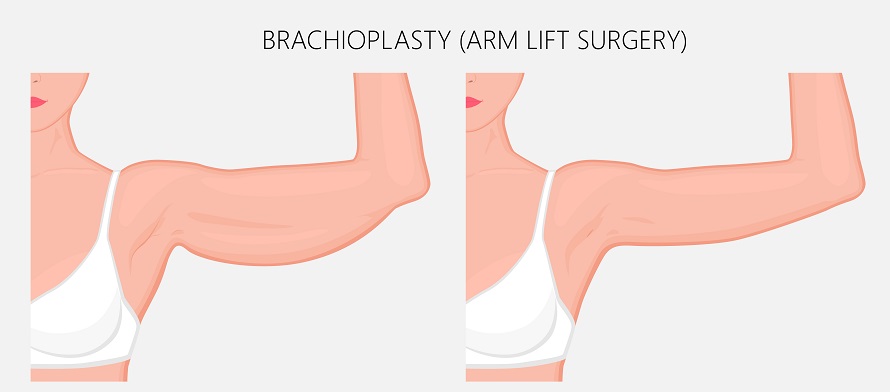
The soft tissue of the arm becomes lax, setting the stage for ptosis (sagging), or “bat wings.” Thin people, too, may have sagging upper arms due to the effects of aging and genetics. Even people who engage in regular exercise such as Pilates and strength training cannot get rid of excess, sagging skin that develops in this area.
Preparing for your Arm Lift
Your surgeon will supply you with a list of preoperative instructions to follow in the days and weeks leading up to your arm lift. These instructions may include quitting smoking, as smoking can have deleterious effects on wound healing. Your surgeon will also ask you to stop taking certain medications such as aspirin, non-steroidal anti-inflammatory medications and certain vitamins and supplements that are known to increase bleeding risk.
Some doctors may also suggest that you take certain supplements before your surgery to reduce swelling and bruising. These may include arnica or bromelain. A high-protein diet may also enhance the healing process. Talk to your doctor about what type of nutritional regimen is recommended before your arm lift.
The Arm Lift Procedure
An arm lift typically takes one to three hours depending on the extent of the surgery. It may involve local anesthesia with intravenous sedation — leaving you awake, but not totally aware — or general anesthesia.
Liposuction alone may be sufficient for people with smooth skin and just a small amount of flab. The arm lift procedure may benefit people with larger areas of fat underneath the arms, poor skin quality and sun-damaged skin.

To perform an arm lift, your surgeon will make incisions on the inside or back of your arm. The incision pattern varies based on the extent of the surgery and your surgeon’s preferred method of treatment. Incisions typically span from the underarm to just above the elbow.
Some people may only require minimal incisions where the inner, upper arm joins the armpit. This is known as a minimal incision arm lift. You may be a candidate for a minimal incision arm lift if you have a small amount of extra skin located near the armpit.
Others, including people who have lost massive amounts of weight following bariatric surgery, may have more excess skin and need an incision that runs from the elbow to the arm pit and onto the side of the chest.
After the incision is made, excess fat may be removed with liposuction. Excessive skin is then trimmed, tightened and sutured in place with absorbable sutures or stitches that will be removed within one or two weeks of the surgery. At this stage your skin will be smooth over the new contour of your arm.
Recovering From Your Arm Lift
You should expect some swelling, bruising and mild discomfort after the procedure, but your arm should appear trim and toned almost immediately. Your surgeon can prescribe prescription pain medication to help alleviate this pain.
Swelling will peak two to three days after your arm lift, typically dissipating within two weeks. Elevating your arm with pillows can help reduce swelling and increase your comfort during recovery.
Dressings are typically applied to the incision. Many of the stitches will dissolve, but those that are not self-absorbing are usually removed within a week. Your surgeon may prescribe a compression garment to allow the skin to adhere to underlying tissues.
It’s OK to shower one week after the procedure, and most people can go back to work two to three weeks after the procedure. Your surgeon will likely tell you to avoid any strenuous exercise for one month, and to avoid heavy lifting for at least six weeks. Individual instructions vary.
Additional cosmetic procedures may further improve your arm’s appearance, including hair removal in your forearm and upper arm areas.
Risks of Arm Lift
No surgery is risk free. Arm lift risks include:
- Infection
- Hematoma
- Anesthesia risks
- Loss of sensation
- Scarring
- Swelling of the hands
- Seromas (fluid-filled masses along the incision line)
Choose a Board-certified Plastic Surgeon
The best way to minimize your risks and maximize your satisfaction with the results of your arm lift is to choose a qualified plastic surgeon who is certified by the American Board of Plastic Surgery. Such board certification ensures that your chosen surgeon has had extensive training and is up-to-date on new technology and arm lift techniques.
Consider viewing before-and-after photos of the doctor’s arm lift patients so you have a better idea of what you can expect. Many individuals who opt for arm lift may also be interested in other body contouring procedures, such as thigh lift or body lift. Consult with a surgeon about these procedures during your visit. If you seek an arm lift because you have lost a massive amount of weight as a result of obesity surgery, your bariatric surgeon may be able to recommend a plastic surgeon who specializes in body contouring after massive weight loss. Start your search now.
Arm Lift Cost
The cost of arm lift surgery includes the surgeon’s fee, anesthesia fee and operating room fee. According to statistics from the American Society for Aesthetic Plastic Surgery, the national average for plastic surgeon fees for an upper arm lift is around $3,900. If the arm lift cost is too much to pay at once, ask your surgeon about monthly payments.
About the Reviewer of This Article
Siamak Agha-Mohammadi, MD, PhD, is a board-certified plastic surgeon in Orange County, California. He received his medical degree and completed his doctor of philosophy degree at the University of Cambridge in England and did his residencies in general surgery and plastic and reconstructive surgery at the University of Pittsburgh Medical Center in Pittsburgh, Pennsylvania. An expert in aesthetic surgery after massive weight loss, Dr. Agha-Mohammadi has published articles in many prestigious journals and is a frequent presenter at major medical meetings.